
Nachricht
A Practical Guide to MVP for Website Development
Building a website from scratch can feel overwhelming. There’s always one more feature to add, one more idea to squeeze in. Before you know it, timelines stretch and budgets grow. That’s where an MVP changes the game.
A Minimum Viable Product for website development isn’t about cutting corners. It’s about focusing on what truly matters, launching sooner, and learning from real users instead of assumptions. Done right, it helps you move faster without losing direction.
Let’s break down how to create an MVP for your website in a way that’s practical, realistic, and actually works.
Understanding Website MVPs and Their Purpose
Let us clear something up first. An MVP is often misunderstood. It is not a half-built website thrown online just to say you launched. It is not a buggy prototype full of broken flows. It is not a basic landing page with no real logic behind it. And it is definitely not an excuse for low standards.
An MVP is a fully functional website, just simplified. It focuses on solving one clear user problem and does that well. It exists to test assumptions in real conditions. Most importantly, it is built for learning, not for showing off.
When people hear the word “minimum”, they tend to associate it with something cheap or incomplete. That misses the point. The real meaning of minimum in this context is focus.
If your first version tries to tackle five different problems at once, you will struggle to validate any of them properly. An MVP narrows everything down to the core value and puts it directly in front of real users. It creates a controlled environment where you can see whether the idea truly resonates before you invest further time and resources.
Why Website MVPs Matter More Than Ever
Most digital products do not fail because of poor code or weak design. They fail because there is no real market demand. Nobody truly needed what was built.
Website MVP development protects you from three expensive mistakes:
- Building features users do not care about
- Overinvesting before validating demand
- Launching too late and missing market timing
There is also a quieter benefit that often gets overlooked. Clarity.
When you limit your website to essential functionality, you are forced to answer uncomfortable but necessary questions:
- What is the actual problem?
- Who is this really for?
- What must work from day one?
- What can wait without harming the core value?
That discipline sharpens your thinking. It often reshapes your strategy for the better. Instead of chasing ideas, you start building with intention. And that shift alone can change the trajectory of your product.
Website MVP Pricing
The cost of a website MVP depends on complexity. A simple informational MVP may cost in the low thousands. An interactive platform with user accounts and payments often falls into the mid to high five figures. More complex systems with advanced logic, custom integrations, or strict security requirements can cost significantly more.
Key cost drivers include feature scope, design depth, integrations, security needs, and team size. The purpose of an MVP is to reduce financial risk. If the first version costs nearly as much as a full product, the scope is too large.
When to Scale
Scaling makes sense when core metrics show steady growth, users return consistently, and conversion rates stabilize. Another signal is when feedback shifts from questioning the core concept to requesting specific improvements.
At that stage, you can expand features, improve infrastructure, optimize performance, strengthen branding, and increase marketing efforts. Scale based on evidence, not assumptions.
How Mobian Approaches Website MVPs
Bei Mobian, we build dedicated engineering teams and full-scale digital platforms for companies that care about quality and long-term growth. When it comes to website MVP development, we see it as more than just a quick launch. For us, it is a strategic starting point. We begin by understanding your business goals, your users, and the core problem your product needs to solve. Then we assemble a focused team that works only on your project, fully integrated into your processes. No shared developers, no divided attention, just clear ownership and steady progress.
We offer both team augmentation and end-to-end development, depending on what your product needs. Whether we are strengthening your in-house capabilities or building a platform from the ground up, we design MVPs with scalability in mind. Even the first version is written to support future growth. After launch, we stay involved to measure results, improve functionality, and help you move from validation to sustainable expansion. For us, an MVP is not the finish line. It is the foundation for building something that lasts.
Step-by-Step Process for Building a Website MVP
Building a website MVP is not about moving fast at any cost. It is about moving with intention. Each step should reduce uncertainty and bring you closer to real validation, not just a launch date.
Below is a practical, no-fluff roadmap that helps you focus on what matters, avoid unnecessary complexity, and turn your idea into a working website that users can actually test and respond to.
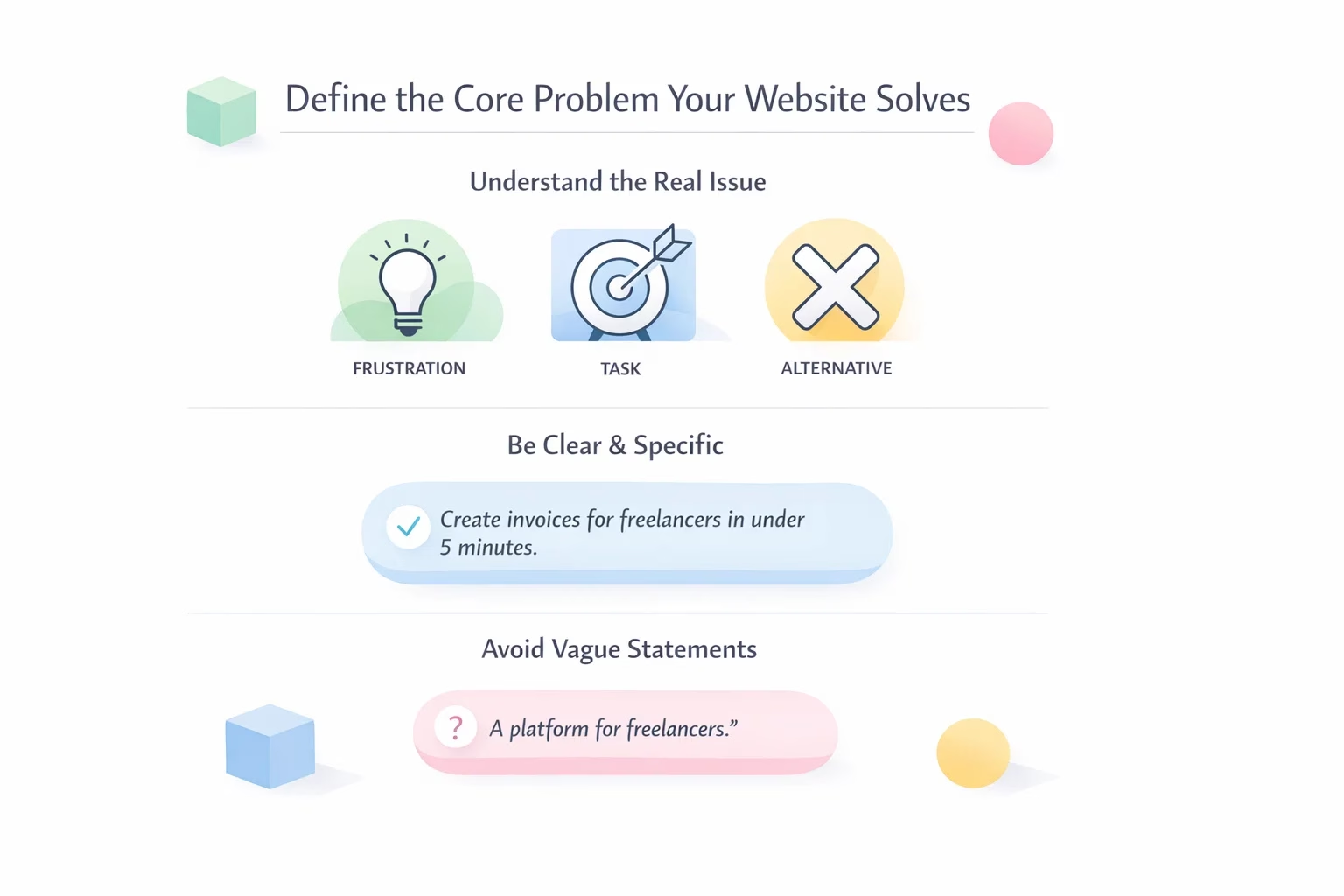
Step 1 – Define the Core Problem Your Website Solves
Before sketching layouts or selecting tools, clarity is essential. The foundation of any website MVP is a precise understanding of the problem it solves. Vague statements like “We connect people” or “We simplify digital experiences” may sound appealing, but they do not guide real product decisions. Without a clearly defined frustration or task, development quickly loses focus.
The problem should be concrete and specific. It should describe the exact difficulty users face, the task they are trying to complete, and the alternative they currently rely on. If the core issue cannot be explained in two simple sentences, the idea is not ready for execution.
For example, instead of saying “a platform for freelancers,” define it as “a website that helps freelancers generate professional invoices in under five minutes without accounting knowledge.” That level of clarity creates direction. Without it, MVP development turns into feature guessing rather than purposeful building.
Step 2 – Identify Your Early Adopters
An MVP is not built for the entire market. It is built for early adopters. These are the people who genuinely feel the problem you are trying to solve. They are actively looking for alternatives, open to trying something new, and realistic enough to accept small imperfections if the core value is clear. Most importantly, they give honest feedback.
If you try to appeal to everyone in your first version, you will end up adding too many features and losing focus. Instead, narrow your audience. Ask yourself who experiences this problem most often, which specific demographic or professional group deals with it daily, and where these people spend their time online. Then create a simple persona that outlines their age range, role, main challenge, current solution, and what they care about most. When you design and build your MVP, it should feel almost as if it was created specifically for them.
Step 3 – Define Success Before You Build
Most teams dive into development and only later start asking whether the MVP actually worked. That is backward.
Before you build anything, define what success looks like. Decide which metric will prove the idea has traction. It might be a specific number of user signups, consistent usage of the core feature, or a certain level of retention after the first week. In some cases, early revenue may be the signal you need.
Common indicators of MVP success include user registrations, activation rate, frequency of feature usage, conversion to paid plans, retention after 7 or 30 days, and direct qualitative feedback from early users. You do not need all of them. Choose two or three measurable metrics and keep the focus tight. If you do not set clear criteria in advance, almost any outcome can feel like progress, even when it is not.
Step 4 – Prioritize Features Ruthlessly
This is where most website MVPs fail. You start with a list of 25 features. You convince yourself that 18 are essential. Suddenly, you are building a full product.
Instead, follow a simple prioritization framework:
- Must-have – Without this, the core problem is not solved.
- Should-have – Improves experience but not critical.
- Could-have – Nice but unnecessary for validation.
- Not-now – Intentionally postponed.
Be strict. If removing a feature does not weaken the core value of your product, it probably does not belong in the MVP. The first version should include only what is absolutely necessary to deliver the main benefit.
Take an online marketplace as an example. An MVP might only require user registration, the ability to create basic listings, simple search functionality, and a straightforward payment integration. That is enough to test whether buyers and sellers are willing to interact and complete transactions.
Features like advanced filtering, AI-based recommendations, detailed analytics dashboards, or multi-language support can wait. Those improvements should be driven by real user demand, not assumptions made before launch.
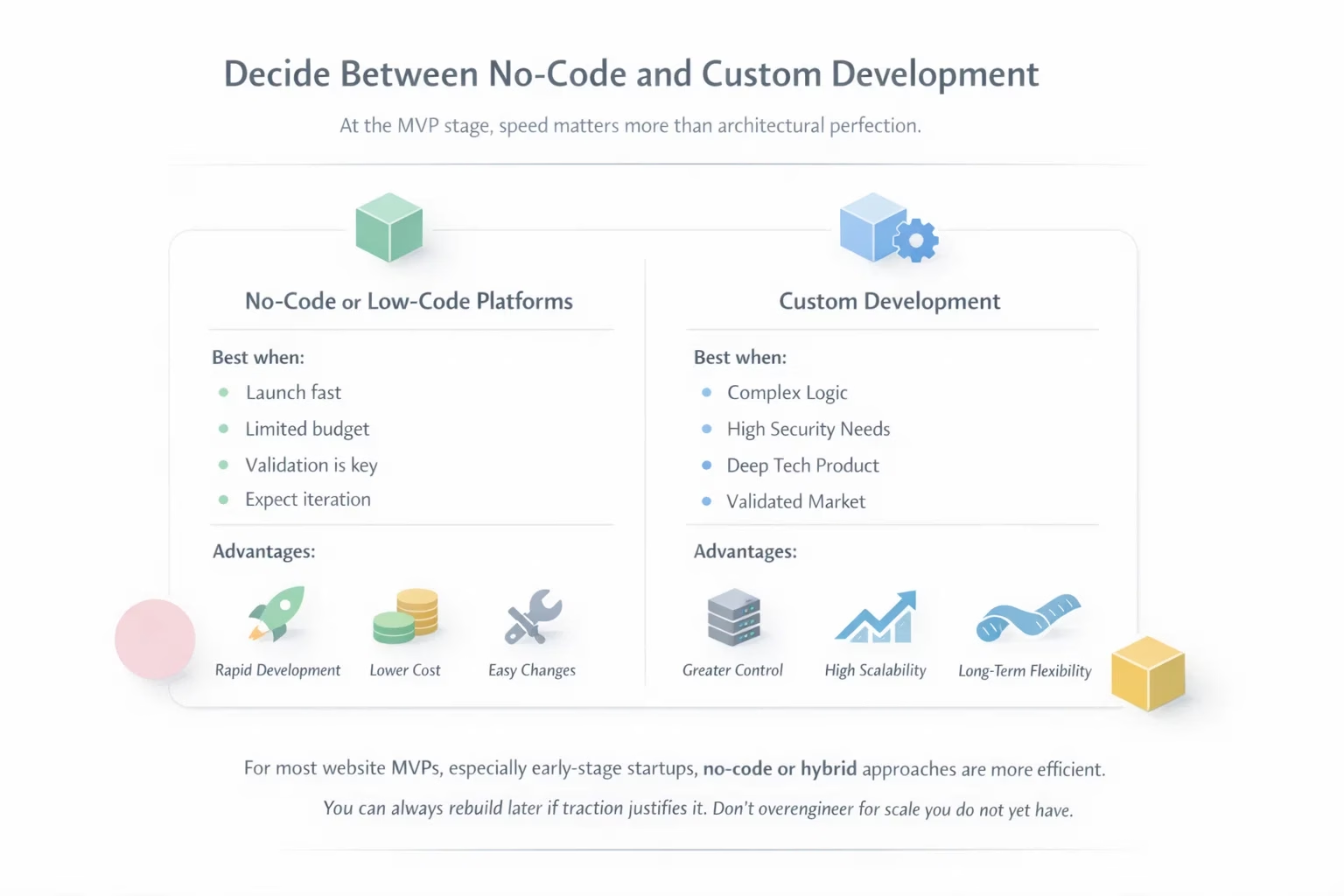
Step 5 – Decide Between No-Code and Custom Development
At the MVP stage, speed matters more than architectural perfection.
You have two primary paths:
No-Code or Low-Code Platforms
Best when:
- You need to launch fast
- Budget is limited
- Validation is the primary goal
- You expect iteration
Vorteile:
- Schnellere Entwicklung
- Lower upfront cost
- Easier changes after launch
- Suitable for non-technical founders
Custom Development
Best when:
- You require complex logic
- Security or compliance demands are high
- The product is deeply technical
- You already validated demand elsewhere
Vorteile:
- Greater control
- High scalability potential
- More flexibility long term
For most website MVPs, especially early-stage startups, no-code or hybrid approaches are more efficient. You can always rebuild later if traction justifies it. Do not overengineer for scale you do not yet have.
Step 6 – Build a Prototype Before Full Development
Even though an MVP is meant to be functional, creating a quick prototype beforehand can save you from unnecessary development work. A simple set of wireframes that maps the main user flow, the primary action, the registration process, and the core interaction is often enough to reveal gaps in logic or usability.
The design does not need to be polished. The goal is clarity. Once you have a basic prototype, test it with a small group of five to ten target users. Run short usability sessions and observe how they navigate the flow. Pay attention to where they hesitate or get confused. If users cannot immediately understand what the website does or complete the main action without guidance, that is valuable insight. Catching these issues early prevents costly rework later, before a single line of final code is written.
Step 7 – Keep Architecture Simple
One of the biggest hidden risks in MVP development is overcomplicating the technical foundation. It is tempting to design a sophisticated architecture from day one, but that often slows everything down without adding real value at the validation stage.
For an MVP, keep the architecture simple. Avoid complex microservices unless there is a clear and unavoidable reason. Instead of building every component yourself, rely on proven third-party integrations. Payment processors, authentication services, analytics tools, and email automation systems are widely available and reliable. Recreating them from scratch only increases cost and development time. At this stage, your priority is learning from users, not demonstrating technical sophistication.
Step 8 – Design for Clarity, Not Decoration
In an MVP, user experience matters more than visual perfection.
A few practical principles:
- Clear headline explaining value
- Obvious primary action button
- Minimal distractions
- Straightforward navigation
- Short onboarding steps
Many MVPs fail for a simple reason: users do not understand what to do within the first 10 seconds. If the value is not clear immediately, attention is lost just as quickly.
Reduce friction wherever possible. The purpose of the website should be obvious at first glance, and the main action should feel natural and easy to follow. If clarity requires explanation, the structure likely needs simplification.
Step 9 – Test Internally Before Launch
Even a minimal product must work reliably. Simplicity does not mean instability. Before launch, test every main user flow to make sure the core action works without friction. Verify that payments process correctly, review how the website behaves on mobile devices, fix any critical usability issues, and confirm that analytics tracking is properly set up.
An MVP is not an excuse for broken experiences. If early users run into technical problems, their feedback will focus on frustration instead of the actual value of your idea. That kind of noise makes it much harder to learn what truly works and what needs improvement.
Step 10 – Launch Softly
Do not chase massive exposure at the very beginning. A wide launch might look exciting, but it can overwhelm your team before you are ready to respond properly.
Start small. Release the MVP to a limited audience, invite early adopters directly, and share it within niche communities where your target users already spend time. You can also offer early access to a selected group who are willing to test and provide feedback.
A controlled launch gives you space to monitor performance, fix issues quickly, and observe real user behavior without pressure. Think of the first release as a learning phase, not a publicity campaign. Growth can come later, once the foundation is solid.
Step 11 – Measure Behavior, Not Just Opinions
User feedback is valuable, but behavior tells the real story. People might say they like the idea or that they would use the product, but those words do not always translate into action. What matters is what they actually do once they interact with your website.
Look at the data. Did they sign up? Did they come back after the first visit? Did they complete the main action you designed the MVP around? Did anyone pay? These measurable actions reveal genuine interest far more clearly than positive comments.
To understand the full picture, combine quantitative data and qualitative insight. Use analytics tools to track behavior, heatmaps to see where users click or hesitate, short surveys to capture impressions, and direct interviews to explore their motivations. Together, these signals help you separate curiosity from real demand.
Step 12 – Iterate Based on Evidence
Now comes the most important part. Launch is not the finish line. It is the beginning of real learning.
After your MVP goes live, take a close look at what actually happens. Notice which features get used the most and where users tend to drop off. Pay attention to repeated complaints and unexpected behaviors. Sometimes what surprises you is more valuable than what confirms your assumptions.
Based on that evidence, make focused decisions. You might improve the core feature, add one high-impact enhancement, simplify a confusing flow, or even rethink the direction entirely. Iteration should be thoughtful, not reactive. Resist the urge to add features just because one person suggested them. Patterns matter more than isolated opinions.
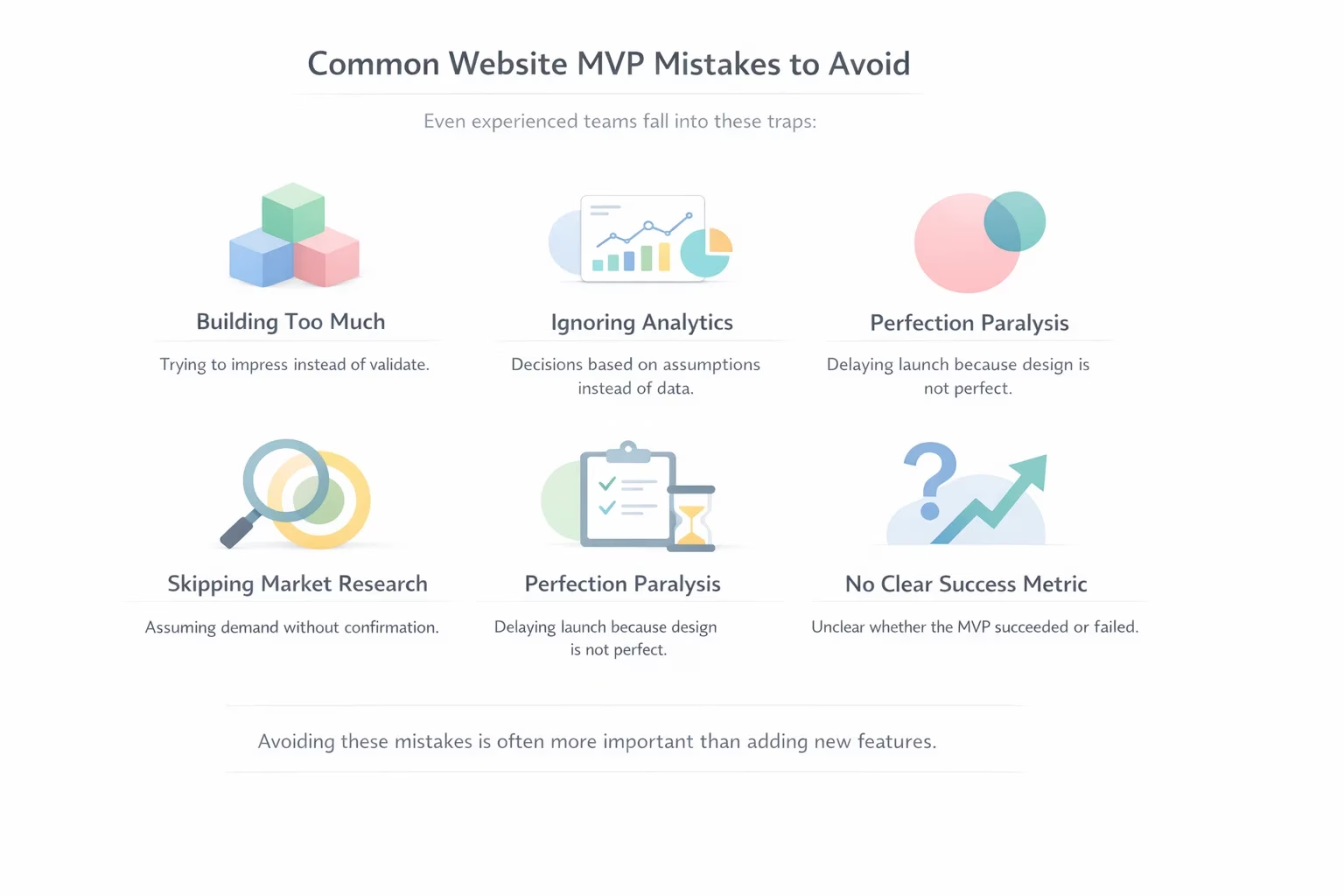
Common Website MVP Mistakes to Avoid
Even experienced teams fall into these traps:
1. Building Too Much
Trying to impress instead of validate.
2. Ignoring Analytics
Making decisions based on assumptions instead of data.
3. Skipping Market Research
Assuming demand without confirmation.
4. Perfection Paralysis
Delaying launch because design is not perfect.
5. Poor Onboarding
Users leave before understanding the value.
6. No Clear Success Metric
Unclear whether the MVP succeeded or failed.
Avoiding these mistakes is often more important than adding new features.
Schlussfolgerung
A website MVP is about validation, not volume. It forces you to focus on one real problem, one defined audience, and a limited set of essential features. That clarity reduces risk and replaces assumptions with data.
When you define success early, launch with discipline, and measure real behavior, you gain something far more valuable than a polished first release. You gain direction. From there, every next step is based on evidence, not guesswork.
Häufig gestellte Fragen
1. What is the purpose of a website MVP?
The purpose is to validate your idea with real users before investing heavily in development. It helps you confirm that your solution solves a meaningful problem and has real demand.
2. How long does it take to build a website MVP?
Most website MVPs take one to three months to develop, depending on scope and complexity. If it takes much longer, the feature set is likely too broad.
3. How many features should a website MVP include?
Only the features required to deliver the core value. If removing a feature does not break the main benefit, it should not be part of the MVP.
4. Can a website MVP be built without custom development?
Yes. Many MVPs are built using no-code or low-code tools. These platforms allow faster validation and lower upfront investment, especially at early stages.
5. When should you scale beyond the MVP?
Scaling makes sense when key metrics show consistent growth, users return regularly, and engagement proves that the core idea works. Expansion should follow evidence, not optimism.
Ready to stop rebuilding and start shipping?
Most of our engagements start with a single conversation about where your current team is stuck. No pitch deck, no obligations.


