
Nouvelles
Directus CMS Pricing: Self-Hosted vs Cloud Plans 2026
Quick Summary: Directus offers flexible pricing: free self-hosting forever under BSL 1.1 (Business Source License) license for organizations earning under $5M annually, or managed cloud plans starting at $99/month for Professional tier. Enterprise custom pricing is available for larger organizations with advanced needs and custom resource limits.
Headless CMS pricing can make or break project budgets. Some platforms charge per seat. Others bill based on API requests or bandwidth.
Directus takes a different approach—one that’s caught the attention of developers tired of escalating SaaS bills. The platform offers free self-hosting alongside flexible cloud tiers, but the pricing structure has nuances worth understanding before committing.
Here’s the thing though—pricing transparency matters. Community discussions reveal that one user’s Nuxt 3 static site with just 1,000-1,200 daily page views generated 40,000 API requests per day on Directus Cloud, highlighting how usage-based costs can surprise teams.
Understanding Directus Pricing Models
Directus operates on two distinct pricing tracks: self-hosted and cloud. Each serves different organizational needs.
Self-Hosted: The Free Forever Option
According to official Directus pricing, organizations with less than $5M in total annual income (revenue and any funding) can self-host Directus free. This applies to production environments and commercial projects.
The platform runs under a BSL 1.1 (Business Source License) license, giving full control over infrastructure, deployment configuration, and hardware choices. Since Directus ships as a Docker image, deployment flexibility is substantial.
But wait. Free doesn’t mean zero cost.
Self-hosting requires infrastructure investment. Server costs, DevOps time, security maintenance, and backup systems add up. For manufacturing companies, third-party cost estimates suggest annual implementation and hosting expenses ranging from $20,000 to $35,000 when factoring in infrastructure and development time.
Cloud Tiers: Managed Hosting Options
Directus Cloud eliminates infrastructure management through fully managed hosting with automatic updates, scaling, and backups. Deployment takes roughly 90 seconds.
Current cloud pricing structure:
| Tier | Monthly Cost | Studio Users | Database Entries | API Requests/Month | Bandwidth/Month | File Storage
|
|---|---|---|---|---|---|---|
| Professionnel | $99 | 5 included | 75,000 | 250,000 | 500 GB | 150 GB |
| Entreprise | Custom | Custom | Custom | Custom | Custom | Custom |
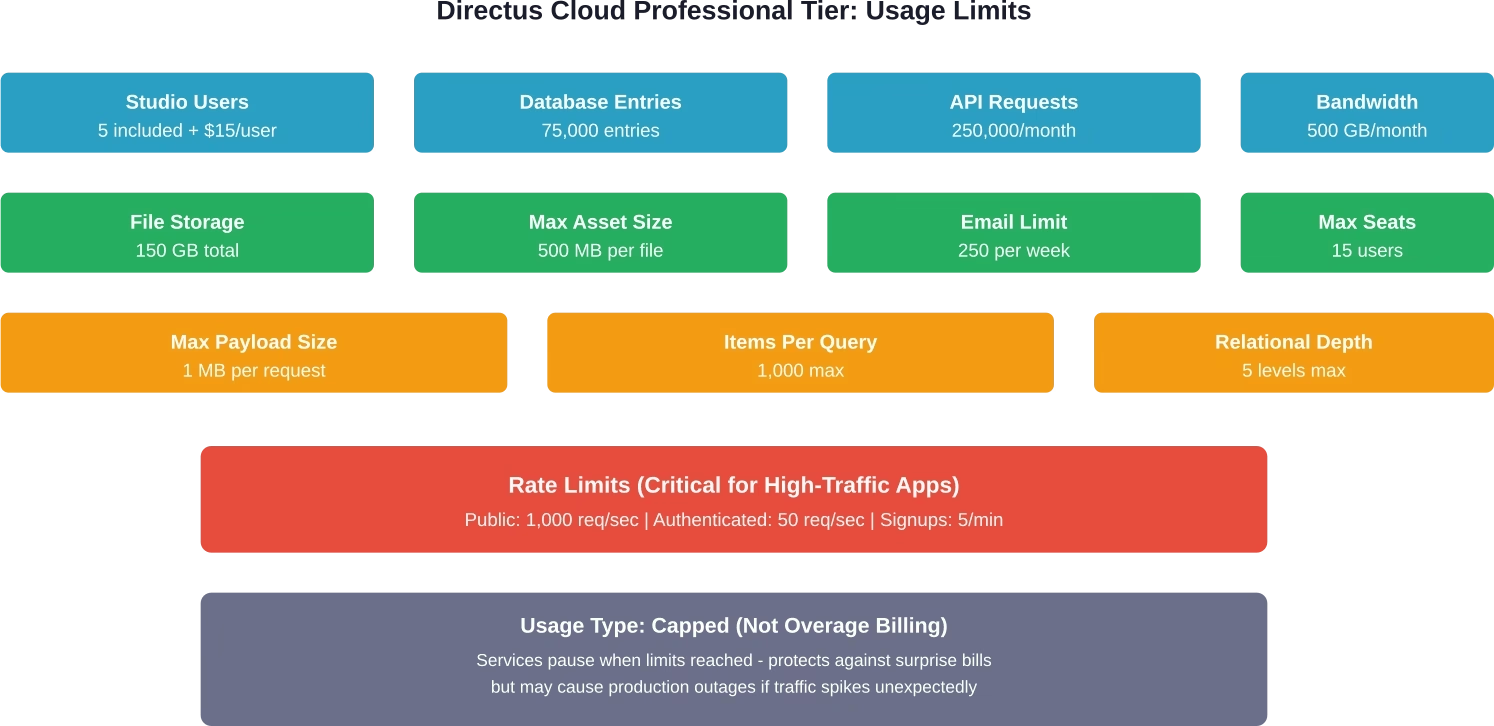
Additional studio users on the Professional tier cost $15 per user. According to the cloud policies documentation, the Professional tier caps at 15 maximum seats.
Breaking Down Professional Tier Limits
The Professional tier technical limits deserve scrutiny. Community experiences show these constraints matter more than they initially appear.
Official cloud policies specify:
- Max body payload size: 1 MB
- Max batch chunk size: 100 items
- Max relational depth: 5 levels
- Max email send limit: 250 per week
- Max items per query: 1,000
- Max public requests per second: 1,000
- Max authenticated requests per second: 50
The API request counting methodology matters significantly. User reports indicate that image and video asset delivery counts toward API request totals, which can rapidly consume the 250,000 monthly allocation even with modest traffic.
One developer noted that offloading media to external CDN services became necessary to control costs—adding complexity to the architecture.
Hidden Costs and Gotchas
Usage-based pricing creates budget uncertainty. The Professional tier implements usage caps rather than overages, meaning services stop when limits are reached.
Real talk: This protects against surprise bills but can cause production outages mid-month if traffic spikes unexpectedly.
What Counts as an API Request?
The definition matters. Based on community discussions, these actions trigger API requests:
- Content queries from frontend applications
- Asset and media file delivery
- Authentication checks
- Webhook triggers
- Real-time subscription updates
Static site generators making repeated builds can rack up requests quickly, especially when pulling media assets through the Directus API rather than serving them directly from CDN infrastructure.
Storage Considerations
The 500 MB asset size limit and 150 GB total storage on the Professional tier suits many projects. But video-heavy applications or high-resolution image libraries hit these ceilings fast.
Enterprise tier offers custom limits. Pricing isn’t published—it requires direct sales contact.
Comparing Directus to Competitor Pricing
Context matters when evaluating CMS costs. Competitor pricing structures vary significantly.
Directus vs Strapi
Strapi offers free self-hosting similar to Directus. Cloud pricing follows a different model with costs scaling by API requests and storage. For manufacturing implementations, Strapi’s estimated annual costs range from $40,000 to $45,000—notably higher than Directus.
Performance benchmarks show Directus with faster response times. According to comparative benchmarks, Directus averaged 35ms response time versus Strapi’s 130ms, with lower memory usage (180MB vs 250MB) and quicker startup times (5 seconds vs 8 seconds).
Directus vs Payload CMS
Payload takes a developer-first approach with code-based configuration ideal for version control. Estimated implementation costs for manufacturing companies fall between $30,000-$45,000 annually for self-hosted deployments.
Payload shows the fastest performance metrics in head-to-head comparisons: 28ms average response time, 150MB memory usage, and 4-second startup time.
Enterprise Alternatives
Contentful and Sanity operate on usage-based SaaS models with costs that can scale aggressively. According to startup community reports cited in industry sources, Sanity bills can jump from $0 to $1,000+ monthly as traffic increases, sometimes faster than revenue growth.
These platforms target enterprise customers with budgets to match. Directus positions itself differently—accessible to smaller teams while scaling to enterprise needs.
| Plate-forme | Self-Hosted | Entry Cloud Tier | Est. Annual Cost (Manufacturing) | Avg Response Time
|
|---|---|---|---|---|
| Directus | Free (under $5M) | $99/month | $20K-$35K | 35ms |
| Strapi | Gratuit | Usage-based | $40K-$45K | 130ms |
| Payload | Gratuit | Usage-based | $30K-$45K | 28ms |
When Self-Hosting Makes Sense
Infrastructure control appeals to specific use cases. Data sovereignty requirements, compliance mandates, or existing DevOps capacity make self-hosting attractive.
The free self-hosting option for organizations under $5M removes licensing concerns. But infrastructure isn’t free.
Teams need to calculate:
- Server hosting costs (AWS, Azure, Google Cloud, or dedicated hardware)
- Database infrastructure and backup systems
- CDN services for media delivery
- SSL certificates and domain management
- Monitoring and alerting tools
- DevOps engineer time for maintenance and updates
For agencies running multiple client projects, self-hosting one Directus instance serving multiple databases can provide significant cost advantages over per-project SaaS fees.
When Cloud Pricing Works Better
Managed hosting removes operational overhead. Teams without dedicated DevOps resources benefit most.
Professional tier at $99/month targets production applications with moderate traffic. The 250,000 API request ceiling requires monitoring, particularly for media-heavy sites.
Sound familiar? That’s the usage-based pricing trade-off: predictable monthly costs with the risk of hitting hard limits.
Enterprise Tier Considerations
Custom pricing kicks in for organizations needing:
- Higher resource limits across all dimensions
- Advanced configurability beyond basic tier restrictions
- Dedicated support and SLA guarantees
- Custom integrations or feature development
- Multi-region deployment or specific compliance requirements
According to official documentation, Enterprise tier offers tailored configurations matching specific organizational requirements rather than fixed limit brackets.
Cost Optimization Strategies
Several approaches reduce Directus cloud costs without compromising functionality.
External CDN Integration
Moving asset delivery to external CDN services (Cloudflare, AWS CloudFront, Bunny CDN) prevents media files from consuming API request quotas. One developer reported needing to implement this architectural change after experiencing 40,000 daily API requests on a site with only 1,000-1,200 daily page views.
Implementation requires configuring Directus to store assets in external object storage (S3, Backblaze B2, or similar) and serving them through CDN URLs rather than Directus API endpoints.
Caching Strategies
Implementing aggressive caching at multiple layers reduces API calls:
- Browser caching for static content
- CDN edge caching for frequently accessed data
- Application-level caching with Redis or Memcached
- Static site generation reducing real-time API dependency
For static site generators like Nuxt, Gatsby, or Next.js, building less frequently and relying on cached builds prevents repeated content fetching.
Selective Data Fetching
Optimizing GraphQL queries or REST API calls to request only necessary fields reduces payload sizes and request counts. The max relational depth limit of 5 encourages efficient query design rather than deeply nested data structures.
Avoid Hidden Costs – Get the Setup Right From the Start
Choosing between self-hosted and cloud plans in Directus is only part of the pricing picture. The real cost often comes from development, integrations, and maintaining the system over time. Without the right setup, what looks cheaper upfront can quickly turn into higher effort and delays. This is where a development team like Mobien can help, especially when projects need proper implementation beyond initial configuration.
Mobian focuses on building and scaling digital products, covering backend development, integrations, and long-term support as systems grow. They typically work alongside internal teams, helping structure the technical side so it stays manageable as the product evolves.
If you’re trying to keep costs predictable while still moving fast, it’s worth reaching out to Mobien early and getting a clear view of what your setup will actually require.
Migration and Lock-In Considerations
Data portability matters for long-term planning. Directus connects directly to SQL databases (PostgreSQL, MySQL, MariaDB, MS SQL Server, or Oracle), meaning data never lives exclusively within Directus.
Database-first architecture provides an exit path. Organizations can migrate away from Directus while retaining their database schema and content—unlike platforms where data exports become complex migration projects.
Cloud to self-hosted migration is straightforward: export database, deploy Directus to owned infrastructure, import database. Directus configuration lives in the database, simplifying portability.
Making the Pricing Decision
Directus pricing flexibility suits different organizational contexts. The free self-hosting option removes barriers for smaller teams and startups while cloud tiers provide managed convenience.
The short answer? Calculate total cost of ownership beyond monthly subscription fees.
Self-hosting requires DevOps capacity. Cloud requires monitoring usage patterns. Both approaches work—the right choice depends on existing team skills, infrastructure investments, and project requirements.
For organizations under the $5M threshold, self-hosting Directus free eliminates licensing costs entirely. Infrastructure expenses remain, but platform costs disappear.
Teams preferring managed services find value in cloud tiers if usage patterns fit within published limits. The Professional tier suits moderate-scale production applications. Enterprise tier serves complex requirements with custom configurations.
Look, headless CMS pricing remains complex across the industry. Directus stands out with transparent limits and the genuine free self-hosting option for smaller organizations.
Check the official Directus pricing page for current tier specifications, as updates occur periodically. The July 2024 Starter tier introduction and November 2025 cloud tiers update demonstrate ongoing pricing evolution responding to user feedback.
Consider running proof-of-concept projects on the Professional tier to validate usage patterns before committing to higher tiers. Monitoring API request counts, bandwidth consumption, and storage usage during testing prevents surprises in production.
FAQ
Is Directus really free for commercial use?
Yes. Organizations with under $5M in total annual income can self-host Directus free under BSL 1.1 (Business Source License) license for all production and commercial projects. No licensing fees apply.
What happens when I hit Professional tier limits?
Directus Cloud implements hard caps rather than overage billing. Services pause when limits are reached, preventing surprise charges but potentially causing temporary outages if traffic spikes unexpectedly.
Do images count as API requests in Directus Cloud?
Based on user experiences, asset delivery through Directus API counts toward API request quotas. Offloading media to external CDN infrastructure prevents assets from consuming request limits.
How does Enterprise tier pricing work?
Enterprise tier uses custom pricing negotiated based on specific requirements. Resource limits, support level, SLA guarantees, and special features factor into pricing. Contact Directus sales for quotes.
Is self-hosting cheaper than cloud for small projects?
It depends. The Professional tier at $99/month. Self-hosting becomes cost-effective at scale or when leveraging existing infrastructure investments.
Can I run multiple projects on one Directus instance?
Yes. Directus supports multi-tenancy through database-per-project architecture. A single self-hosted instance can serve multiple client projects, making it cost-effective for agencies compared to per-project SaaS fees.
Ready to stop rebuilding and start shipping?
Most of our engagements start with a single conversation about where your current team is stuck. No pitch deck, no obligations.


